
Reading the warehouse shots of a pair before the box call
What PinguBuy looks at, what you should look at, and what the photos tell you about the box.
Checked against PinguBuy pages and its estimator on 10 November 2026
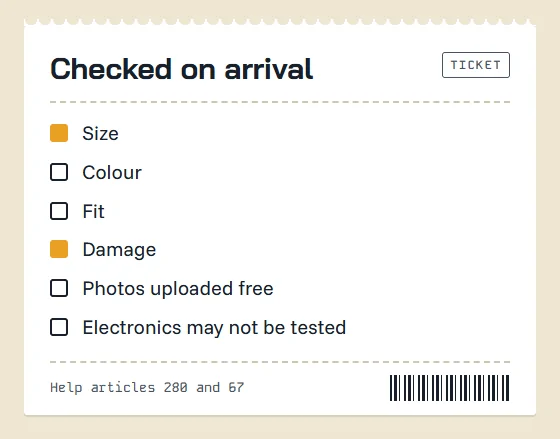
Size, colour, fit, damage: the arrival check
PinguBuy's quality inspection article is short and plain about its limits. Staff check basic attributes only: size, colour, fit and damage. A few photos go up free, and judging them is your job. A separate article adds that the check is general and that electronics may not be tested.
If a pair is wrong, you can ask for a return, and PinguBuy will negotiate with the seller, but it says plainly that not every return succeeds. So the photos are your evidence and your decision point. PinguBuy's inspection scope
A seven-point pass over shoe QC shots
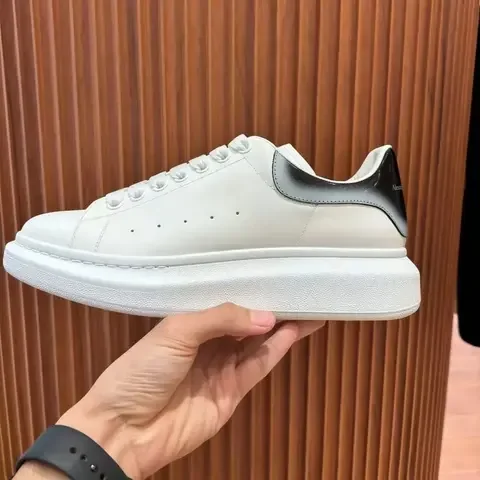
Below is a routine for how to check QC photos of trainers and boots. A fixed order helps. Size first: find the tag stitched under the tongue, or the sticker on the end of the box, and match it to your order note on both shoes. Then the pair itself: two of the same size, a left and a right, the same colour under the same light.
Then the build. Look along the line where upper meets sole for glue marks or gaps, at the toe and heel for creasing, and at the stitching on eyelets and heel tabs. Compare the colour with the seller's listing photo rather than with memory. Finally, look at the box, because the next decision is whether it travels.
- Size label on both shoes matches the size in your order note.
- One left, one right, same size, same colourway.
- Glue line along the sole: no thick smears or open gaps.
- Toe box and heel counter keep their shape; no deep creases.
- Stitching straight at the eyelets, heel tab and collar.
- Colour matches the listing photo, not just the name of the variant.
- Box condition, if you plan to keep it: corners, lid and any label.
When the box itself matters
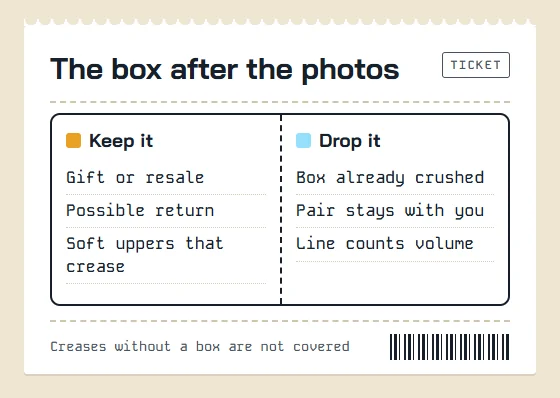
The photos often show the box, and its state is part of the choice. A box already crushed in domestic transit protects less and still costs the full volume, so dropping it costs you little. A clean box matters if the pair is a gift, if you may sell it on, or if you might send the pair back.
Keep in mind the parcel cover rule: creases and slight deformation on items sent without their shoebox are not covered. If the shoes have a soft upper that creases easily, the box is doing real work. What the box costs on each line
Sending a pair back: two different clocks
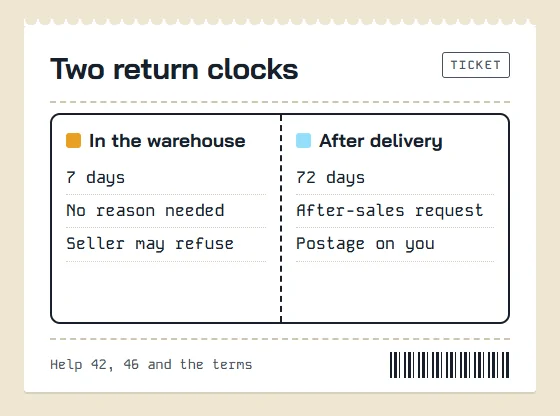
PinguBuy runs two separate time limits, and they are easy to mix up. In the warehouse, it offers seven-day no-reason returns or exchanges, counted while the item sits there; its help also says a return request is possible if the item has not been in the warehouse more than seven days. After delivery, its terms accept after-sales applications for 72 days.
The first is for changing your mind after seeing the photos. The second is for problems found once the pair is on your feet. For quality faults inside a warranty period, PinguBuy can contact the seller for you if you have the original receipt and quality card, but return postage is yours and an international return usually takes more than a month. PinguBuy's returns article